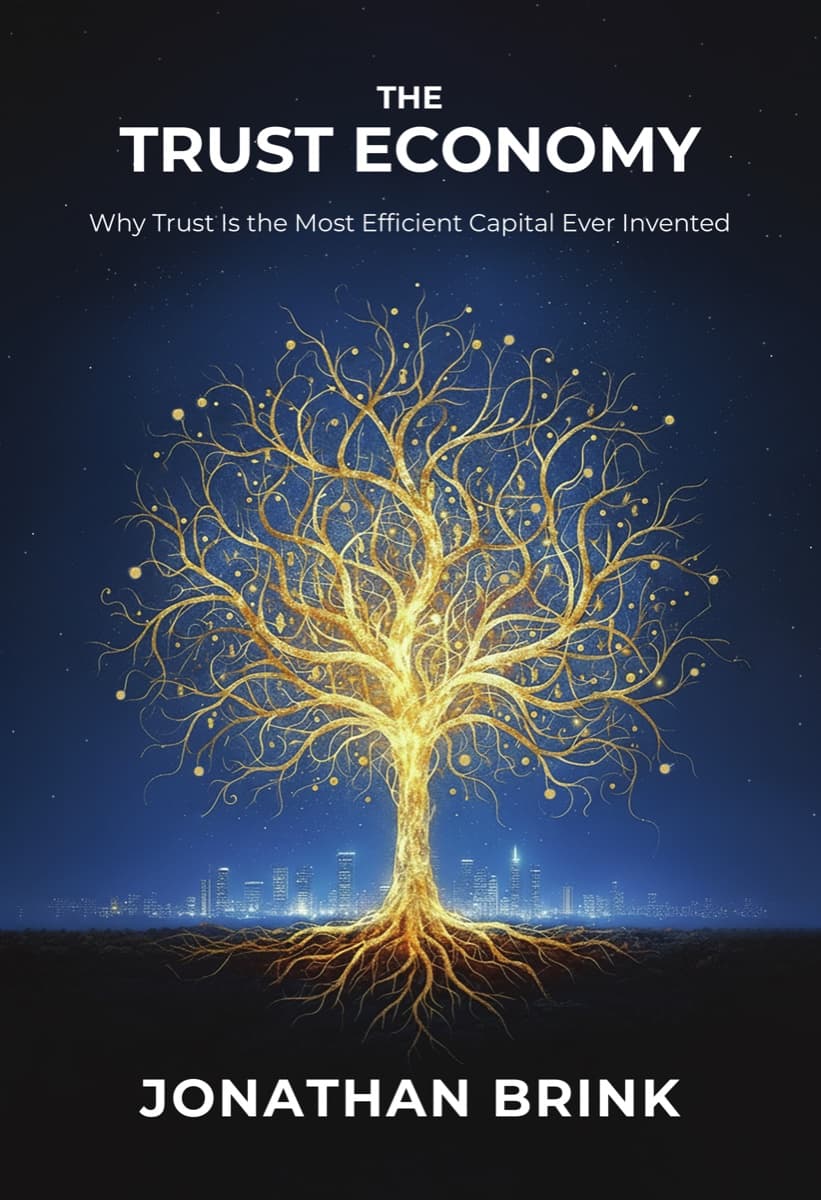
The Trust Economy
Harnessing the Most Efficient Capital Ever Invented
What if trust isn't just nicer—but cheaper, faster, and more resilient?
The premise is simple.
For fifty years, we've built economic systems on one assumption: humans are self-interested, competition drives progress, and the invisible hand optimizes for everyone.
But what if that assumption is incomplete?
The Trust Economy makes an engineering claim, not a moral one: trust-based systems outperform extraction-based systems by every measurable metric.
This book proves it—and shows you how to build them.
What you'll learn
The Idiot Index
A metric that reveals how much you're paying for distrust in every transaction. (Spoiler: it's more than you think.)
The Five Frequencies
The spectrum from chronic distrust to coherent faith—and how organizations move between them.
The Friction Formula
Less noise = less friction = more flow = more abundance. The math of trust.
The Surplus Principle
Why trust creates more to share—and scarcity is a choice, not a constraint.
The Architecture
Complete blueprints: consent-based governance, the Unity Token, the Partnership Agreement, the Trust Stack.
The Proof
Case studies from Handelsbanken to Buurtzorg to Nordic economies. Already working. Already measurable.
Who this is for
Leaders who sense there's a better way to build organizations
Economists who know the models are missing something
Parents building a world for the next generation
Anyone tired of systems that work against human nature
Builders who want blueprints, not just critique
About Jonathan
Jonathan Brink spent thirty years in Silicon Valley—at IBM, Charles Schwab, and startups of his own—learning where systems break. Where confusion happens. Where trust gets lost.
As a father of six, his motivation is personal: building an economy his children can thrive in. The Trust Economy is his answer.
Read more about Jonathan →Get the book
Hardcover
$28
Ebook
$14.99
Audiobook
Coming Soon
For Book Clubs
The Trust Economy makes for rich discussion. We've created a free discussion guide with questions for each section.
Download Discussion Guide (PDF)